
Why Do We Need Prebiotics? The Role of Fermentable Substrates in Microbiome, Metabolic and Intestinal Barrier Homeostasis
Introduction
Over the past decades, dietary fiber has undergone a fundamental reinterpretation. From a simple non-digestible component of the diet, long considered “roughage,” it has become a central element in understanding the relationship between nutrition, the gut microbiome, metabolism and inflammation. However, the concept of a prebiotic goes beyond the general notion of dietary fiber. Not every fiber is prebiotic, and not every non-digestible substrate produces the same effects on the intestinal ecosystem.
Prebiotics represent a category of dietary or supplemental substrates that are selectively utilized by host microorganisms and confer a health benefit. This modern definition shifts the focus from mere non-digestibility to the biological interaction between the substrate, the microbiota and the host response.
From a clinical perspective, interest in prebiotics is justified by their involvement in the regulation of intestinal transit, the production of short-chain fatty acids, intestinal barrier integrity, immune modulation, glucose and lipid metabolism, satiety, low-grade systemic inflammation and, indirectly, in conditions associated with intestinal dysbiosis.
Dietary Fiber, Non-Digestible Carbohydrates and Prebiotics: Conceptual Distinctions
Dietary fibers are, broadly speaking, non-digestible carbohydrates and lignin naturally present in plants. They include plant cell wall polysaccharides such as cellulose, hemicelluloses and pectins, as well as compounds such as gums, mucilages, fructans, resistant starch and certain oligosaccharides.
From a functional perspective, fibers may be classified according to solubility, fermentability and viscosity.
Insoluble fibers, such as cellulose, lignin and certain hemicelluloses, are poorly fermentable or non-fermentable. They increase fecal bulk, accelerate intestinal transit and exert a predominantly mechanical effect on bowel evacuation.
Soluble fibers, such as pectins, gums, mucilages, beta-glucans and some hemicelluloses, may form viscous gels, delay glucose and lipid absorption and undergo fermentation by the colonic microbiota.
Prebiotics are a functional subcategory. They are not defined solely by their resistance to digestion by human enzymes, but by their capacity to be selectively utilized by beneficial microorganisms and to generate favorable effects for the host.
Among the most extensively studied prebiotics are:
- fructo-oligosaccharides;
- inulin;
- galacto-oligosaccharides;
- lactulose;
- resistant starch;
- beta-glucans;
- pectins;
- arabinoxylans;
- partially hydrolyzed guar gum;
- certain polyphenols with indirect prebiotic effects.
This distinction is clinically important. A patient with simple constipation may benefit from insoluble fibers, whereas a patient with dysbiosis, irritable bowel syndrome, bloating or FODMAP sensitivity may require a much more careful selection of fiber type.
Mechanisms of Action of Prebiotics
The effects of prebiotics are mediated through several complementary mechanisms.
1. Selective Utilization by the Gut Microbiota
Prebiotics promote the growth or activity of bacterial groups considered beneficial, particularly Bifidobacterium, Lactobacillus, Faecalibacterium prausnitzii, Eubacterium rectale, Roseburia spp. and other short-chain fatty acid-producing bacteria.
This selectivity does not mean that a prebiotic stimulates only one bacterial species. Rather, it promotes beneficial metabolic networks within the intestinal ecosystem. The microbiome functions through metabolic cooperation, not through the isolated action of a single bacterium.
An important example is bacterial cross-feeding. Some bacteria degrade complex carbohydrates into intermediate metabolites, which are then used by other species for butyrate production. Thus, the clinical effect of a prebiotic depends not only on the presence of a specific species, but also on the integrity of a functional microbial network.
2. Production of Short-Chain Fatty Acids
Fermentation of prebiotics in the colon generates short-chain fatty acids: acetate, propionate and butyrate.
Acetate is the most abundant and may be used peripherally in energy metabolism. Propionate is involved in hepatic gluconeogenesis, lipid metabolism and appetite regulation. Butyrate is the main energy source for colonocytes and plays a major role in maintaining colonic mucosal integrity.
Butyrate supports the expression of tight junction proteins, modulates intestinal permeability, inhibits excessive activation of pro-inflammatory pathways and acts as a histone deacetylase inhibitor, thereby influencing gene expression and cellular differentiation.
In this sense, prebiotics are not merely “food for bacteria,” but precursors of metabolites with systemic biological effects.
3. Maintenance of the Intestinal Barrier
The intestinal barrier includes the mucus layer, intestinal epithelium, intercellular junctions, the mucosal immune system and the resident microbiota. Dysfunction of this barrier is implicated in low-grade chronic inflammation, metabolic syndrome, allergies, autoimmune diseases, inflammatory bowel disease and functional digestive disorders.
By increasing the production of short-chain fatty acids, especially butyrate, prebiotics may contribute to the maintenance of intestinal barrier integrity. In addition, certain fermentable fibers stimulate mucus secretion and support colonization by beneficial mucin-degrading bacteria, such as Akkermansia muciniphila, in favorable metabolic contexts.
It should be emphasized, however, that these effects depend on dose, substrate type, baseline microbiota composition and individual tolerance.
4. Modulation of the Immune Response
The gut microbiota and its metabolites are involved in the education of the immune system. Short-chain fatty acids influence the activity of dendritic cells, macrophages, regulatory T lymphocytes and cytokine production.
Prebiotics may support a more tolerogenic immune state at the mucosal level, reducing local inflammatory hyperreactivity. This mechanism is relevant in the context of allergies, inflammatory bowel disease, post-infectious irritable bowel syndrome and metabolic inflammation.
However, overinterpretation should be avoided. Prebiotics are not specific immunological treatments and should not be presented as therapies for cancer, severe infections or autoimmune diseases. They may have an adjuvant role by supporting the intestinal ecosystem and mucosal homeostasis.
5. Effects on Glucose and Lipid Metabolism
Soluble and fermentable fibers may influence the postprandial glycemic response by increasing the viscosity of intestinal contents, slowing gastric emptying and reducing the rate of glucose absorption.
In addition, metabolites produced through fermentation may modulate the secretion of enteroendocrine hormones such as GLP-1 and PYY, which are involved in satiety, insulin response and appetite regulation.
Beta-glucans from oats and barley are among the best-documented fibers with effects on LDL cholesterol. The mechanism includes increased intestinal viscosity, binding of bile acids, increased bile acid excretion and the use of hepatic cholesterol for the synthesis of new bile acids.
In metabolic syndrome, prebiotics may contribute to the improvement of certain components such as postprandial hyperglycemia, dyslipidemia, low-grade inflammation and excess body weight, although the effect depends on the overall dietary context.
Beta-Glucans: Metabolic Fibers with Documented Effects
Beta-glucans are soluble polysaccharides found in oats, barley, yeasts and certain mushrooms. Their structure differs depending on the source, and this structural difference partly explains their distinct biological effects.
Beta-glucans from oats and barley are recognized primarily for their metabolic effects. They increase the viscosity of intestinal contents, reduce cholesterol absorption and contribute to lowering LDL cholesterol. The effect is best documented for an intake of approximately 3 g/day of beta-glucans from oats or barley.
Beta-glucans from yeasts and mushrooms have been studied mainly for their immunomodulatory effects, through interaction with receptors of innate immunity, including dectin-1 and complement receptors. These effects are biologically interesting, but should not be translated into excessive clinical claims. Data regarding infection prevention or oncology are heterogeneous and depend on the type of beta-glucan, dose, population and clinical context.
From a practical standpoint, dietary beta-glucans can be integrated into the diet through the consumption of oats, barley and whole-grain products rich in soluble fiber. Supplementation should be individualized, especially in patients with significant bloating, fermentative dysbiosis or irritable bowel syndrome.
Resistant Starch
Resistant starch is a form of starch that escapes digestion in the small intestine and reaches the colon, where it may be fermented by the microbiota. It is found in legumes, whole grains, greener bananas and cooked-and-cooled starchy foods such as potatoes or rice.
Through fermentation, resistant starch promotes butyrate production and may have favorable effects on insulin sensitivity, satiety and colon health.
There are several types of resistant starch, depending on structure and origin: physically inaccessible starch, native granular starch, retrograded starch and industrially modified starch. Digestive tolerance varies significantly from one patient to another.
PHGG: Partially Hydrolyzed Guar Gum
Partially hydrolyzed guar gum is a soluble fiber obtained through the controlled hydrolysis of guar gum. It is important to distinguish it from regular guar gum, which may have high viscosity and poorer digestive tolerance.
PHGG has lower viscosity, is easier to administer and is often better tolerated. In clinical studies, it has been evaluated in irritable bowel syndrome, constipation, functional diarrhea and bloating.
Through gradual fermentation, PHGG may increase the production of short-chain fatty acids and support the growth of beneficial bacteria, without producing as much discomfort as some rapidly fermentable fibers.
In clinical practice, PHGG is one of the useful options in patients with bloating, irregular bowel habits or poor tolerance to classical fibers, but it should be introduced progressively.
Prebiotics and the Gut–Metabolism Axis
The relationship between prebiotics and metabolism is one of the most important current research directions. Intestinal dysbiosis has been associated with obesity, insulin resistance, metabolic dysfunction-associated steatotic liver disease, type 2 diabetes mellitus and metabolic syndrome.
Possible mechanisms include:
- reduction of metabolic inflammation;
- modulation of metabolic endotoxemia;
- increased production of short-chain fatty acids;
- regulation of GLP-1 and PYY secretion;
- influence on bile acid metabolism;
- support of intestinal barrier integrity;
- modification of the intestinal bacterial profile.
Prebiotics do not replace metabolic treatment, but they may represent an adjuvant nutritional intervention, especially when integrated into a coherent dietary plan involving the reduction of ultra-processed foods and increased plant diversity.
Prebiotics in Functional Digestive Disorders
In irritable bowel syndrome, the use of prebiotics requires caution. Rapidly fermentable fibers, such as inulin or fructo-oligosaccharides, may worsen bloating, flatulence and abdominal pain in sensitive patients.
By contrast, fibers with slower fermentation and better tolerance, such as psyllium or PHGG, may be more appropriate in certain clinical phenotypes.
This difference explains why a patient may react poorly to one “prebiotic” and favorably to another. The term prebiotic is not sufficient for clinical decision-making. Chemical structure, solubility, fermentability, dose, rate of introduction and the patient’s baseline microbiota all matter.
Prebiotics, Probiotics, Synbiotics and Postbiotics
Prebiotics are often confused with probiotics.
Probiotics are live microorganisms that, when administered in adequate amounts, confer a health benefit on the host.
Prebiotics are substrates selectively utilized by host microorganisms.
Synbiotics are combinations of probiotics and prebiotics, designed either complementarily or synergistically.
Postbiotics are preparations of inanimate microorganisms and/or their components that confer a health benefit on the host.
This terminology is important because many commercial products use these terms imprecisely. From a medical perspective, recommendations should be based on mechanism, indication and tolerance, not on the generic label of “biotic.”
Individualizing Administration
Prebiotic administration should be adapted to the clinical context.
In patients with constipation, fibers may be beneficial, but adequate fluid intake must be ensured and intestinal motility should be assessed.
In patients with severe bloating, SIBO, visceral hypersensitivity or a low-FODMAP diet, certain prebiotics may aggravate symptoms.
In patients with metabolic syndrome, dyslipidemia or insulin resistance, soluble fibers such as beta-glucans, psyllium and certain fermentable fibers may have metabolic value.
In patients with inflammatory bowel disease, the use of prebiotics should be correlated with disease activity, digestive tolerance and background therapy.
In oncological, immunocompromised or postoperative patients, any intervention targeting the microbiome should be discussed in a medical context, without unjustified extrapolations from experimental studies.
The practical clinical rule is to start with low doses, increase gradually and monitor bowel habits, bloating, abdominal pain, stool consistency, food tolerance and metabolic markers when appropriate.
Dietary Sources of Prebiotics
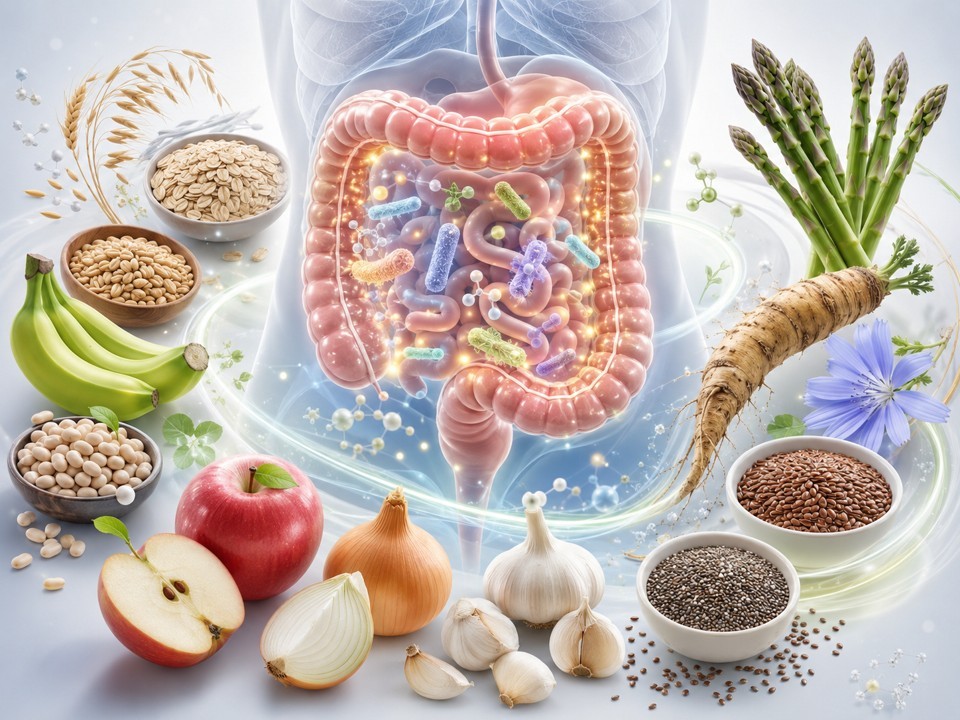
Relevant dietary sources include:
- oats and barley, for beta-glucans;
- legumes, for resistant starch and fermentable fibers;
- onion, garlic, leek, asparagus, artichoke and chicory, for fructans;
- greener bananas, for resistant starch;
- apples, citrus fruits and berries, for pectins and polyphenols;
- flaxseeds and chia seeds, for mucilages;
- cooked-and-cooled potatoes and rice, for retrograded starch;
- mushrooms, for specific beta-glucans;
- products containing PHGG or other soluble fibers, in selected indications.
However, dietary sources must be adapted to digestive tolerance. A patient with FODMAP sensitivity may not tolerate onion, garlic or inulin, even though these are classical prebiotics.
Conclusions
Prebiotics represent a major component of modern nutritional medicine because they connect diet with the microbiome, immunity, the intestinal barrier and metabolism.
They should not be reduced to the simplistic idea of “fiber for bowel transit.” Prebiotics are functional substrates capable of modifying the metabolic activity of the microbiota and promoting the production of biologically important metabolites, particularly short-chain fatty acids.
Their benefits may include regulation of intestinal transit, support of the intestinal barrier, modulation of inflammation, improvement of glycemic response, reduction of LDL cholesterol, increased satiety and support of a more resilient microbiota.
At the same time, their use must be individualized. Not all fibers are prebiotics, not all prebiotics are tolerated in the same way, and patients with dysbiosis, SIBO, IBS or severe bloating require a gradual and personalized approach.
In medical practice, the question is not only whether the patient consumes fiber, but what type of fiber they consume, what microbiota they have, what symptoms they develop and what clinical objective is being pursued.
Selected References
- Gibson GR, Hutkins R, Sanders ME, et al. Expert consensus document: The International Scientific Association for Probiotics and Prebiotics consensus statement on the definition and scope of prebiotics. Nature Reviews Gastroenterology & Hepatology. 2017.
- EFSA Panel on Dietetic Products, Nutrition and Allergies. Scientific Opinion on the substantiation of health claims related to beta-glucans from oats and barley and maintenance of normal blood LDL-cholesterol concentrations. EFSA Journal. 2011.
- Slavin J. Fiber and prebiotics: mechanisms and health benefits. Nutrients. 2013.
- Makki K, Deehan EC, Walter J, Bäckhed F. The impact of dietary fiber on gut microbiota in host health and disease. Cell Host & Microbe. 2018.
- Gill SK, Rossi M, Bajka B, Whelan K. Dietary fibre in gastrointestinal health and disease. Nature Reviews Gastroenterology & Hepatology. 2021.
- Niv E, Halak A, Tiommny E, et al. Randomized clinical study: partially hydrolyzed guar gum versus placebo in the treatment of patients with irritable bowel syndrome. Nutrition & Metabolism. 2016.
- Carlson JL, Erickson JM, Lloyd BB, Slavin JL. Health effects and sources of prebiotic dietary fiber. Current Developments in Nutrition. 2018.
- Holscher HD. Dietary fiber and prebiotics and the gastrointestinal microbiota. Gut Microbes. 2017.
- Canfora EE, Jocken JW, Blaak EE. Short-chain fatty acids in control of body weight and insulin sensitivity. Nature Reviews Endocrinology. 2015.
- Reynolds A, Mann J, Cummings J, et al. Carbohydrate quality and human health: a series of systematic reviews and meta-analyses. The Lancet. 2019.